
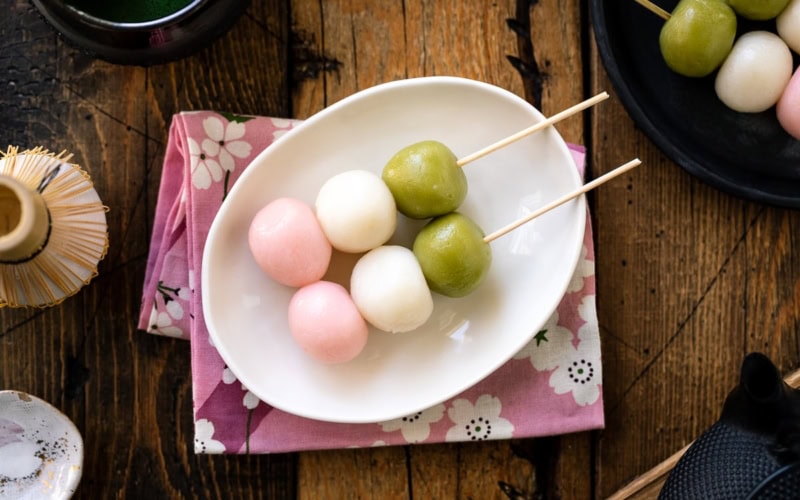
Have you ever seen those tri-colored rice dumplings eaten during springtime in Japan? Soft, chewy, and gently sweet, hanami dango is made from simple, time-honored ingredients, with each color carrying meaning: pink for blossoms, white for purity, and green for new growth.
This article explores hanami dango’s cultural significance and how it’s enjoyed during hanami picnics. We’ll also cover where to find it in Japan and abroad, letting everyone experience this seasonal treat!
What is Hanami

Hanami is Japan’s beloved spring tradition of “flower viewing,” where people gather beneath blooming cherry trees to admire the fleeting beauty of sakura. Families, friends, and colleagues gather in parks, temple grounds, and along rivers to share food, drinks, and laughter under the cherry blossoms.
At its heart, hanami celebrates nature’s delicate beauty and expresses a cultural awareness of impermanence, the understanding that life’s most beautiful moments, like falling sakura petals, are fleeting.
Don’t miss the cherry blossoms this year! Plan your hanami with our cherry blossom calendar.
If you’re in Tokyo, check out the best cherry‑blossom viewing spots in Tokyo. For Kyoto, see the cherry‑blossom forecast and top viewing spots.
What is Hanami Dango
 Hanami dango is a traditional Japanese sweet made of chewy rice dumplings, served on a skewer in three colors: pink, white, and green. It is soft, chewy, and lightly sweet. It is delicate rather than rich, offering a comforting, nostalgic flavor reminiscent of lightly sweetened mochi. Each color offers a slight flavor difference:
- Pink – subtly fruity, often flavored with strawberry or sakura.
- White – plain and mild.
- Green – earthy, made with matcha or mugwort (yomogi).
This gentle sweetness and tender texture make hanami dango perfect for enjoying during spring picnics or festivals.
Brief History of Dango
Dango are charming little round dumplings made by kneading flour from rice, wheat, buckwheat, or millet with water, then steaming or boiling them. They can be enjoyed plain, coated in sweet red bean paste, rolled in soybean flour (kinako), grilled with soy sauce, or even wrapped with sweet fillings and sprinkled with sesame or nuts.
The name dango has a few fascinating origins. One theory traces it back to “dan-ki” (団喜), a Tang-style sweet introduced to Japan during the Heian period and often offered to Buddhist deities.
Another theory simply points to its shape: “gathered” or “rounded”, which reflects how the flour is kneaded into balls. Over time, the word also came to describe anything clumped together or piled in a lump, just like the dumplings themselves.
Dango has always been more than a snack. It was traditionally part of rituals and seasonal celebrations, from cherry blossom viewing to moon-viewing festivals and even funerals.
Dango has also played a spiritual role in Japan. At the Mitarashi Festival in Kyoto, one of the country’s oldest festivals dating back to the 8th century, dango are offered to deities in three colors: white, red, and green as part of traditional ceremonies.
Over time, dango evolved into many varieties, each enjoyed for its subtle sweetness and chewy texture. They pair perfectly with green tea, making them an ideal snack or breakfast treat. While hanami dango is associated with spring, other types like mitarashi sweet-soy sauce glazed dango, tsukimi moon-viewing dango, and other seasonal variations are enjoyed year-round.
How to Make Hanami Dango

Making hanami dango at home is surprisingly simple and takes less than an hour. It uses just a few ingredients:
- Shiratamako or glutinous rice flour
- Sugar
- Water
- Optional coloring/flavors: strawberries for pink, matcha for green
The dough is kneaded, shaped into balls, boiled until soft and chewy, cooled in an ice bath, and skewered in the traditional green-white-pink order.
Made from a simple mix of rice flour, glutinous rice flour, sugar, and water, these dumplings are easy to prepare! For step-by-step instructions, you can follow our hanami dango recipe. It’s easy, takes less than an hour, and makes 8 skewers, perfect for sharing with family and friends.
Where to Buy Hanami Dango

You can honestly buy hanami dango pretty much anywhere during cherry blossom season, such as at convenience stores, department store food halls, and street stalls in popular hanami spots.
- In Tokyo, depachika (department store food basements) in Ginza and Shibuya feature seasonal hanami dango, while local sweet shops near Asakusa also carry fresh three-colored skewers. Convenience stores and supermarkets offer packaged versions throughout the sakura season.
- In Osaka, you can find hanami dango at department store food halls like Takashimaya and Daimaru, as well as seasonal wagashi shops in Namba and Umeda. Local markets and supermarkets also stock hanami dango packs during spring, especially in April.
- In Kyoto, traditional wagashi stores along Teramachi and Shinkyogoku often sell hanami dango, and well-known confectioners like Kanshundo offer them seasonally.
- In Nara, traditional sweet shops such as Kasen‑do and local confectioners near Nara Park stock hanami dango during the cherry blossom period. Even outside peak weeks, wagashi shops and department store food halls usually have limited seasonal stock.
Hanami dango isn’t just a sweet treat; it’s a bite of spring itself. So don’t miss springtime in Japan without trying hanami dango! Enjoy these soft, chewy, tri-colored treats and experience firsthand how the Japanese celebrate the beauty of cherry blossoms and the joy of the season.
If you're heading to Japan this spring, bdon't forget sure to bookmark this page for the latest cherry blossom forecast and plan your hanami to catch the blooms at their peak.







 English (US) ·