
 1 month ago
41
1 month ago
41
Ask most people about Gunma food. They’ll say yakimanjuu, the grilled steamed buns. That’s fair. But if you’re talking noodles, Tatebayashi deserves your attention.
Tatebayashi udon is one of Gunma’s Big Three regional noodle styles. It stands alongside Mizusawa udon and Kiryu udon. The city sits close to Tokyo. Weekend visitors make the trip regularly. And yet, outside of Gunma, almost nobody knows this noodle exists. Compare it to Sanuki udon from Kagawa or Inaniwa udon from Akita. Tatebayashi barely registers.
Why hasn’t it broken through? Eat a bowl. You’ll find that question hard to shake.
This guide covers everything worth knowing. What the noodle is, why it matters, what it tastes like, and where you can eat it. Stick with it to the end.
TOC
What Is Tatebayashi Udon?
Tatebayashi udon is a hand-cut wheat noodle. It comes from the Tomo area of eastern Gunma Prefecture, centered on Tatebayashi City. Its defining quality is a texture that seems to contradict itself. The noodle feels soft on the first bite. Then you keep chewing. A springy, elastic chewiness builds slowly. Most udon noodles offer one or the other. Tatebayashi manages both.
That texture comes from the wheat and the water. Most Tatebayashi shops use a branded flour called Hyakunen Komugi, which means Century Wheat. Farmers in the Ora-Tatebayashi area grow it. Nisshin Flour Milling grinds it. Nisshin traces its roots to Tatebayashi Flour Milling, a company that started right here in this city. The connection runs deep.
The water matters just as much. Underground springs fed by Mount Akagi flow beneath the city. Locals sometimes call Tatebayashi a town of good water. That clean, soft water shapes the dough in ways that are hard to replicate elsewhere.
The noodles themselves vary across shops. Beyond the standard udon, restaurants serve himokawa udon, a wide and paper-thin ribbon noodle. One shop even offers mayudama udon, kneaded with silk powder from silkworm cocoons. Order from three different restaurants. You get three completely different experiences, even though all three carry the Tatebayashi udon name.
Why Tatebayashi Udon Has a Real Reputation
The Big Three of Gunma udon title carries weight. But Tatebayashi’s reputation goes beyond regional pride. A national udon competition called the Udon Tenkaichi Ketteisen gathers regional noodle styles from across Japan. Tatebayashi’s Oni Himokawa noodle won the top prize three years in a row. That does not happen by accident.
Japan’s Ministry of Agriculture, Forestry and Fisheries officially documented Tatebayashi udon under their Our Local Cuisine project. The ministry recognizes it as a living part of regional food culture. Starting in 1994, local noodle shops, noodle makers, and soy sauce producers formed a joint promotion group. They pushed Tatebayashi udon as a tourism draw for the whole region.
One brand quietly holds the ecosystem together. Shoda Soy Sauce, a local company founded in 1873, has flavored the dipping broth at Tatebayashi udon shops for generations. Wheat, milling, and soy sauce grew up together in this city. Pull any one of them out, and the food culture unravels.
The commercialization of Hyakunen Komugi flour in 2017 added fresh momentum. A branding committee launched in 2019. It expanded the wheat’s use into sweets, ramen, and other products. The farm-to-table movement gave this regional flour new relevance. Tatebayashi udon has ridden that wave.
What Tatebayashi Udon Tastes Like
The first thing you notice is how soft the noodle feels. It lands gently on the tongue. No resistance at all. Then you start chewing. A slow, satisfying elasticity builds. The noodle pushes back. Gently, but clearly. This two-stage texture sets Tatebayashi apart from almost everything else in the udon world.
A faint natural sweetness from the wheat comes through. You notice it most when you eat the noodle plain. Cold zaru udon served with dipping broth on the side makes the best showcase. The broth enhances the noodle without covering it.
Himokawa noodles take things in a different direction. Wider and thinner than standard udon, the Oni Himokawa version at Hanayama Udon measures just 1.52 to 1.55 millimeters thick. At that thickness, the noodle wraps around broth and toppings with every bite. The noodle flavor stays front and center.
Cold dipping noodles are the standard way to order. But hot simmered udon and kamatama udon, which pairs noodles with a raw egg yolk, work just as well. Many shops rotate seasonal menus. Spring brings mountain vegetable tempura. Summer calls for cold broth udon. Winter shifts to a slow-cooked pot-style noodle. The dish changes with the calendar.
Every shop also has its own version. Same wheat, different noodle width, different thickness, different broth seasoning. The regional identity holds everything together. But each restaurant inside it does something personal and distinct.
The History of Tatebayashi Udon
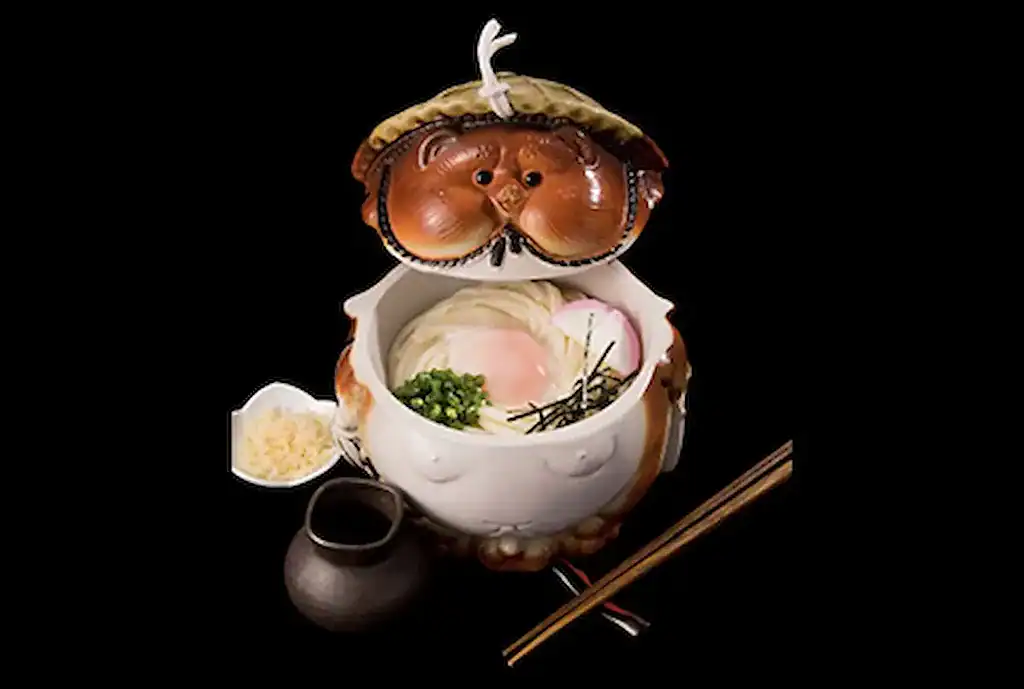 Authentic Tatebayashi udon featuring fresh noodles, green onions, and a soft-boiled egg, presented in a unique ceramic bowl.
A Wheat Region Since the Edo Period
The Tomo region of eastern Gunma has grown wheat for a very long time. The soil drains well and holds nutrients. Winter brings long stretches of sunshine. The Karakaze wind blows cold and dry from Mount Akagi. It pulls moisture from the fields and helps the wheat develop strong, dense grain.
Records from the mid-Edo period show that the Tatebayashi domain presented udon to the Tokugawa shogunate as a regional specialty. The city had already built an identity around noodles centuries before anyone thought to brand it.
The Meiji Era: Milling Takes Root
The next turning point came in the Meiji era. Hanayama Udon opened in 1894. Six years later, in 1900, Tatebayashi Flour Milling Company launched in the city. That company eventually merged into what became Nisshin Flour Milling, now one of Japan’s largest milling corporations. The origin point sits right here in Tatebayashi.
Shoda Soy Sauce founded its operation in the same era. Three industries grew up together: wheat farming, flour milling, and soy sauce brewing. By the end of the Meiji period, Tatebayashi had all the raw ingredients for a genuine food culture.
The Showa and Heisei Eras: Udon as a Community Project
Regional food traditions tend to fade as diets diversify. Tatebayashi udon faced that same pressure. The local response came in 1994. Noodle shops, manufacturers, and soy sauce makers formed a joint promotion group. They pushed Tatebayashi udon to a national audience.
The strategy worked. Hanayama Udon’s Oni Himokawa noodle won the national competition three years running. Word of the city’s noodles spread beyond Gunma. The udon became a reason to visit, not just something locals happened to eat.
Today: Hyakunen Komugi and New Directions
In 2017, the Hyakunen Komugi flour brand launched commercially. Nisshin mills 100 percent Ora-Tatebayashi-grown wheat under that name. A brand committee formed in 2019 and expanded its reach into pastries, sweets, and ramen.
A new specialty dish also appeared. Inspired by the folktale Bumbuku Chagama, which centers on Morin-ji Temple in Tatebayashi, some shops now serve a釜玉udon seasoned with Shoda’s Tosa soy sauce. The dish connects local legend to local food in a way visitors can immediately understand.
History and the present coexist here without much friction. That balance is exactly what Tatebayashi udon is about.
Places to Eat Tatebayashi Udon
Multiple udon restaurants operate in Tatebayashi. Most sit within walking distance of Tatebayashi Station. The three below represent the strongest options for first-time visitors. Hours and closures can change, so checking the website or calling ahead before you visit is a smart move.
Hanayama Udon (はなやま うどん)
Hanayama Udon opened in 1894. It is the oldest and most decorated shop in the city. Their Oni Himokawa noodle won Japan’s national udon competition three years in a row. The flagship Oni Gozen set pairs that wide, paper-thin noodle with thinly sliced wheat-fed pork, a soft-boiled egg, and seasonal tempura. Everything on the plate works together with real precision. The restaurant sits one minute on foot from Tatebayashi Station’s east exit. It’s the natural first stop. A retail shop next door sells packaged noodles to take home.
Address: 2-3-48 Honcho, Tatebayashi City, Gunma
Phone: 0276-74-7766
Website: https://www.hanayamaudon.co.jp/
Udon Honmaru (うどん ほんまる)
Udon Honmaru operates on the ground floor of the Tatebayashi Udon Company’s headquarters. It sits about ten minutes on foot from the station’s east exit. The signature dish is a catfish tempura and udon set. Catfish is a local specialty of the Tatebayashi and Itakura area. The flavor is mild and clean, closer to white fish than anything muddy or strong. Shoda’s Tosa soy sauce accompanies the tempura. The seasonal menu cycles through butterbur sprout tempura in spring, cold broth udon in summer, mushroom dipping broth in fall, and simmered noodles in winter.
Address: 3-8-1 Honcho, Tatebayashi City, Gunma
Phone: 0276-74-0145
Website: https://www.tatebayashiudon.co.jp/
Mayudama Udon Morijn (まゆ玉うどん もり陣)
Morijn sits a seven-minute walk from Morin-ji-mae Station. The restaurant serves mayudama udon, a noodle found nowhere else in Japan. The dough incorporates silk powder ground from silkworm cocoons. Three cocoons go into each serving. The result is a noodle with unusual smoothness alongside its chewiness. It slides cleanly and carries a texture that regular wheat noodles cannot replicate.
The origin story is worth knowing. The owner suffered a stroke. On the advice of a natural medicine practitioner, he began holding silkworm cocoons in his hand. He felt warmth and noticed improved circulation. He became fascinated by the cocoon’s properties. Eventually, he decided to knead it into noodle dough.
The restaurant also serves as a gathering place for fans of the anime A Place Further Than the Universe, which uses Tatebayashi as its setting. Visitors from outside Japan leave notes in the fan journal on the wall.
Address: 1560 Horikucho, Tatebayashi City, Gunma
Phone: 0276-75-0490
Website: https://morijn.jimdofree.com/
Closing Thoughts
Tatebayashi udon grew out of three things coming together in one place. Excellent wheat. Clean water from Mount Akagi. And three industries, flour milling, soy sauce brewing, and noodle making, that developed alongside each other over more than a century. Remove any one of them, and the dish we know today would not exist.
The soft-yet-chewy texture stays with you after the meal. It sits in a category of its own. Different from Sanuki udon’s firm bite. Different from Inaniwa udon’s delicate silkiness. Tatebayashi does something distinct. And it does it consistently across multiple shops.
The city is easy to reach from Tokyo. A day trip built around udon works beautifully. Morin-ji Temple and the Nisshin History Museum sit nearby and add depth to the visit. The noodle gives you a reason to come. The city gives you reasons to stay a few extra hours.
Check Japanese Noodle Page for more Noodle Info!
References
Gunma Prefecture Tourism Official Site, Tatebayashi Udon Feature Article: https://gunma-kanko.jp/features/199
Ministry of Agriculture, Forestry and Fisheries, Our Local Cuisine, Gunma Prefecture: https://www.maff.go.jp/j/keikaku/syokubunka/k_ryouri/index.html
Hyakunen Komugi Branding Committee Official Site: https://100y-komugi.jp/concept/
Hanayama Udon Official Site, History Page: https://www.hanayamaudon.co.jp/history/
Tatebayashi Udon, Regional Cuisine Story Archive: http://kyoudo-ryouri.com/food/1613.html
日本遺産(Japan Heritage)






 English (US) ·