
 1 month ago
45
1 month ago
45
There is a small sushi counter in the basement of a Ginza department store where an elderly itamae has been slicing fish for over forty years. His knife — a single-bevel yanagiba forged in Sakai — cost more than many people spend on a used car. He sharpens it every evening after the last customer leaves. If you ask him about the secret to great sushi, he will not mention rice vinegar ratios or fish sourcing, though he is meticulous about both. He will tell you that the secret is time. In Japan, mastery is not a destination. It is a practice measured in decades.
This philosophy runs through every layer of Japanese food culture, from the multi-course precision of kaiseki to the deceptive simplicity of a bowl of ramen whose broth has been simmering for eighteen hours. It is a culture that prizes patience over speed, process over shortcuts, and incremental refinement over dramatic reinvention. And for anyone willing to look past the obvious surface differences, it offers a remarkably coherent framework for thinking about something that might seem entirely unrelated: how to build lasting wealth through disciplined investing.
The connection is not as strange as it first appears. At The Investors Centre, we spend a great deal of time studying the behavioural patterns that separate successful long-term investors from those who chase short-term gains and burn out. The principles that emerge — patience, discipline, continuous learning, respect for process — are almost indistinguishable from the values that underpin Japanese culinary tradition. Both domains reward the practitioner who commits fully to the long game and punish the one who tries to skip steps.
Shokunin Kishitsu: The Artisan Spirit
Consider the concept of shokunin kishitsu, the artisan spirit. A shokunin is not simply someone who performs a task competently. A shokunin devotes their entire working life to the relentless pursuit of perfection within a single discipline. Jiro Ono, the legendary sushi master profiled in Jiro Dreams of Sushi, spent ten years learning to properly prepare rice before he was permitted to stand behind the counter. This is not inefficiency. It is a profound understanding that mastery requires a foundation so deep that it becomes invisible — and that rushing the foundation guarantees mediocrity.
The investing parallel is striking. The most successful investors in history — Warren Buffett, Charlie Munger, Terry Smith — are not people who found a clever trick and exploited it. They are people who spent decades building an intuitive understanding of how businesses generate value. They read voraciously. They studied failures as carefully as successes. Like the sushi master who sharpens his knife every night, they treated the maintenance of their knowledge as a non-negotiable daily practice.
Kodawari: Uncompromising Attention to Detail
Then there is the principle of kodawari — an uncompromising dedication to the highest standards in every detail. Walk into any serious ramen shop in Tokyo and you will see kodawari at work. The noodles are made in-house to a specific hydration level. The tare is a proprietary blend that took years to perfect. The eggs are marinated for a precise number of hours. Nothing is left to chance. The result is a bowl of ramen that costs eight hundred yen and delivers an experience that many Michelin-starred Western restaurants cannot match.
In investing, kodawari manifests as due diligence — the refusal to commit capital to anything you have not thoroughly researched. It means reading the fund factsheet instead of relying on a headline. It means comparing platform fees down to the basis point. These are small details, but they compound over twenty or thirty years into differences of tens of thousands of pounds.
The Power of Simplicity
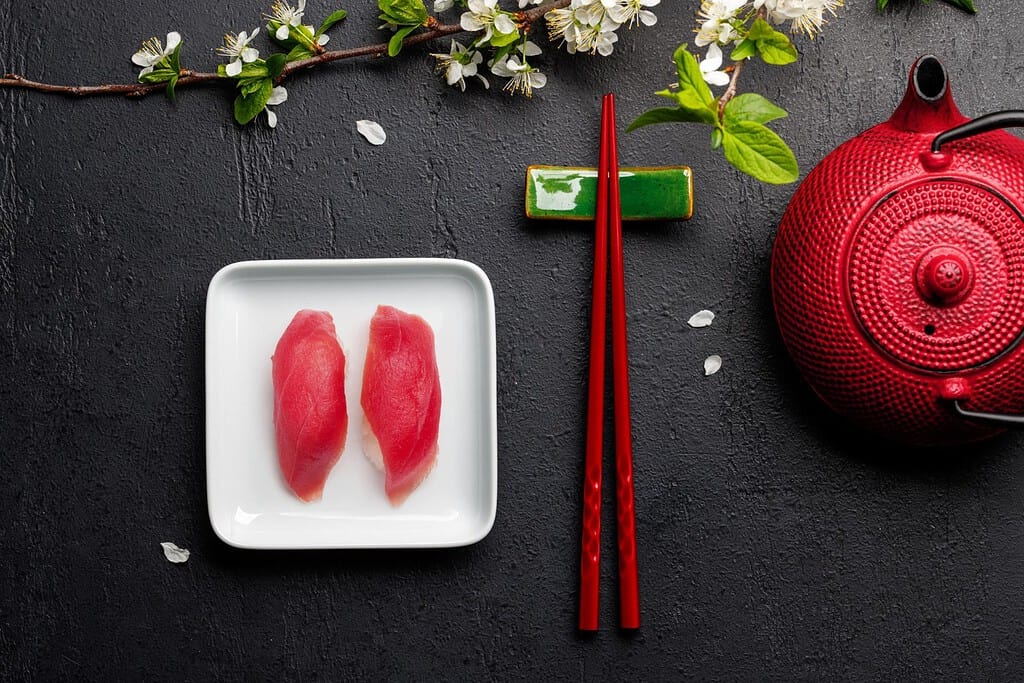
Image by soulpics on Freepik
Japanese food culture also offers a powerful lesson in the value of simplicity. Kaiseki, the formal multi-course meal rooted in Zen Buddhist tea ceremony traditions, is built on the principle that each dish should express the essence of its ingredients with the minimum possible intervention. A piece of grilled ayu sweetfish needs nothing more than salt and heat. A slice of perfect otoro speaks for itself. The chef’s role is not to dazzle with complexity but to select the right ingredients and then get out of the way.
This maps directly onto one of the most robust findings in modern investment research: simple, low-cost, diversified portfolios consistently outperform complex, actively managed strategies over the long term. The investor who buys a global index tracker and holds it for decades is the financial equivalent of the kaiseki chef who lets the ingredient speak. The temptation is always to add more — more trades, more exotic instruments — but evidence overwhelmingly suggests that complexity is the enemy of returns.
Mottainai: Respecting Every Resource

Image by Freepik
There is also the Japanese concept of mottainai, a term that expresses regret over waste and a deep respect for resources. In the kitchen, mottainai means using every part of the fish, repurposing vegetable trimmings into stock, and never discarding anything that still holds value. For investors, mottainai translates into an awareness of how fees, taxes, and unnecessary trading erode returns. Every pound lost to an avoidable charge is a pound that can never compound. The disciplined investor, like the disciplined chef, treats waste as a personal failing.
The Ingredient That Cannot Be Rushed

Image by pvproductions on Freepik
Perhaps the deepest lesson is about time itself. Japanese food culture does not rush. Miso ferments for months. Katsuobushi — the dried bonito flakes essential to dashi — takes six months to produce through smoking, sun-drying, and cultivating a specific mould. There is an innate understanding that the best outcomes require the right conditions and the right duration, and that neither can be artificially compressed. Investing is the same. Compound growth operates on one non-negotiable condition: time. An investor who starts at twenty-five and contributes modestly for forty years will almost certainly outperform someone who starts at forty-five and contributes aggressively for twenty. The ingredient is time. The discipline is patience. The reward is a result that seems disproportionate to the effort — much like the deceptive simplicity of a perfect piece of nigiri that took a lifetime to learn how to make.
Japanese food culture did not set out to teach anyone about investing. But its core principles — patience, precision, simplicity, respect for process, and an unshakeable commitment to the long view — form a philosophy that transfers with remarkable clarity to the world of personal finance. The next time you sit down to a carefully prepared Japanese meal, consider that the same virtues that produced the food on your plate might also produce the financial future you are working toward.








 English (US) ·