
 1 month ago
49
1 month ago
49
Few noodles in Japan are said to carry a story stretching back more than a thousand years. Goto udon (五島うどん), a hand-stretched noodle from Nagasaki’s remote Goto Islands, is one of them. Made about 100 kilometers west of Nagasaki City, these thin, silky strands are unlike anything you’ll find on the mainland. If you haven’t heard of them, that’s partly the point. This is island food — quiet, unhurried, and shaped by centuries of tradition.
Goto udon is often described as one of Japan’s three great regional udon varieties, alongside Sanuki udon from Kagawa and Inaniwa udon from Akita. Of the three, Goto is arguably the least famous outside Japan. Yet many who try it say it’s the most memorable.
TOC
What Is Goto Udon?
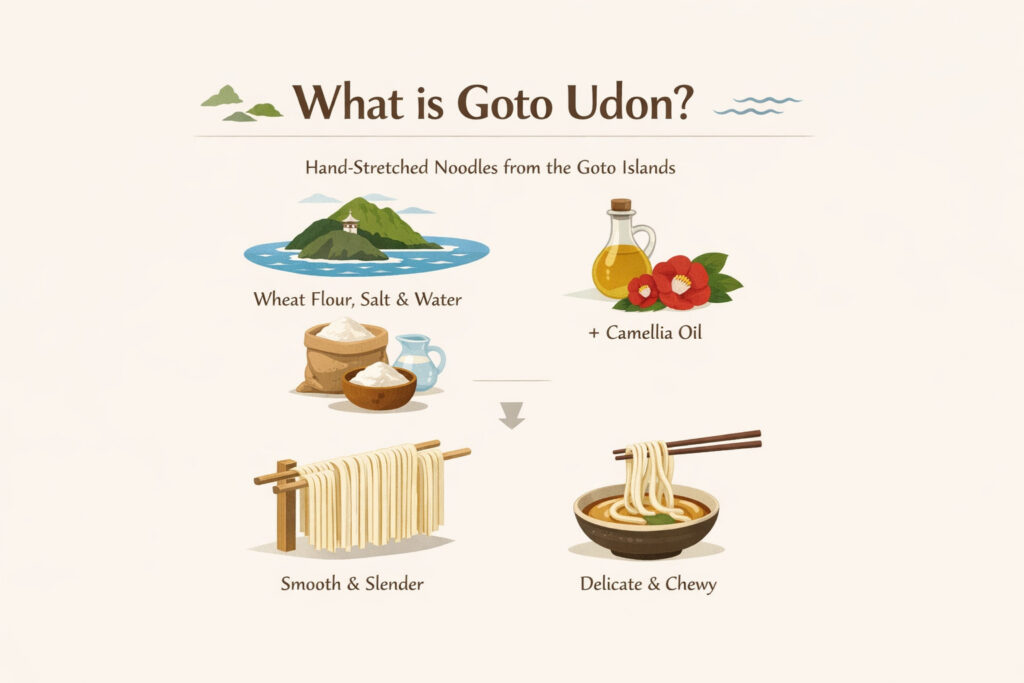
Goto udon is a dried, hand-stretched wheat noodle produced primarily on Nakadorijima island in the Goto archipelago. Standard udon uses just three ingredients: wheat flour, water, and salt. Goto udon adds a fourth — camellia oil (tsubaki abura), pressed from wild camellia trees native to the islands.
That one addition changes everything. The oil coats each strand during the drying process, preventing the noodles from sticking and giving them a distinctly polished, smooth surface. The finished noodle is slender, roughly 1.7 to 2mm thick, and almost perfectly round in cross-section. Regular udon tends to be thicker and flatter. These are fine and cylindrical — closer in appearance to a thinner somen, but with a resilience that’s entirely their own.
What Makes Goto Udon Different?
The hand-stretching method, known as te-yori, involves repeatedly twisting and pulling the dough by hand. This builds the gluten in a specific way, creating what Japanese food makers call koshi — a firm yet springy resistance. This hand-stretched method is valued for producing the noodle’s distinctive balance of elasticity, firmness, and smoothness. Each batch takes considerable time and physical skill.
Camellia oil also does more than add gloss. It helps prevent the noodle strands from clumping, protects the surface structure during boiling, and contributes to the noodle’s slippery mouthfeel. After the oil is applied to the surface of the dried noodles — a step called migaki, or “polishing” — the finished product has a silky finish that holds up even in a hot pot. No preservatives are needed. The oil itself helps extend shelf life naturally.
Goto Udon vs Other Japanese Udon: A Quick Comparison
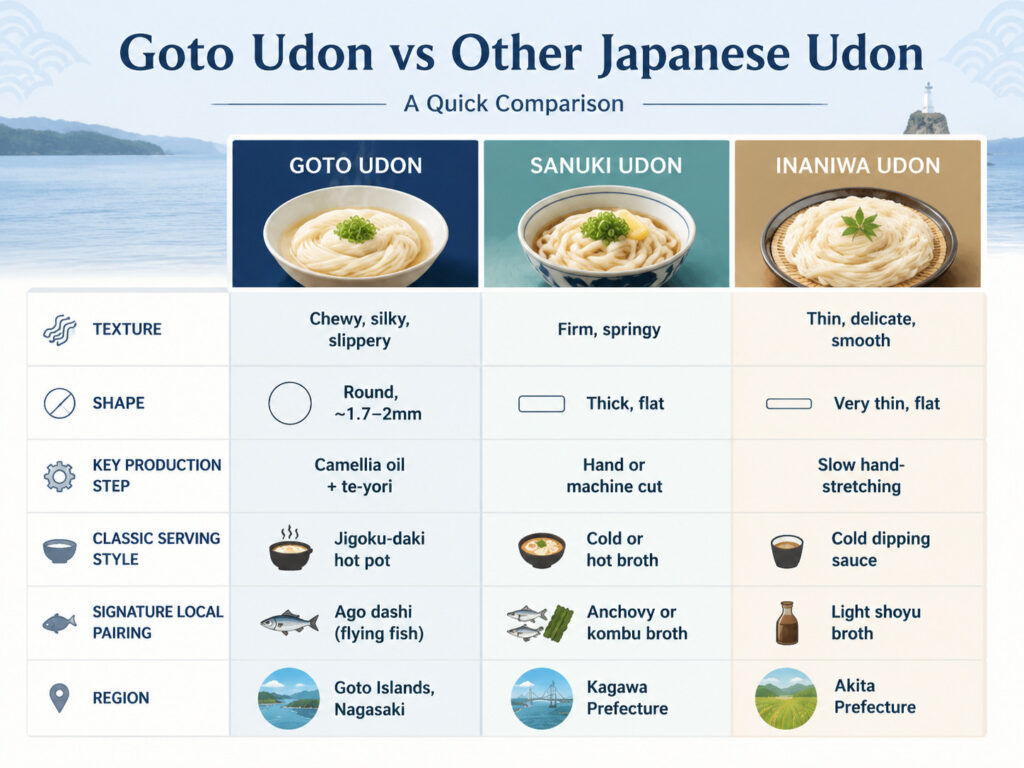
| Texture | Chewy, silky, slippery | Firm, springy | Thin, delicate, smooth |
| Shape | Round, ~1.7–2mm | Thick, flat | Very thin, flat |
| Key production step | Camellia oil + te-yori | Hand or machine cut | Slow hand-stretching |
| Classic serving style | Jigoku-daki hot pot | Cold or hot broth | Cold dipping sauce |
| Signature local pairing | Ago dashi (flying fish) | Anchovy or kombu broth | Light shoyu broth |
| Region | Goto Islands, Nagasaki | Kagawa Prefecture | Akita Prefecture |
What Does Goto Udon Taste Like?
What surprises many first-time eaters is the contrast. The noodles feel delicate at first touch, yet they push back with a springy, satisfying bite. They’re glossy and smooth on the palate — slippery in a way that makes them easy to eat quickly, before the heat of a jigoku-daki pot fades.
The flavor of the noodle itself is mild. There’s a faint, lingering note of camellia oil even after boiling, though it never feels greasy. The real character comes from the broth. Paired with ago dashi — the flying fish stock native to the islands — the combination tastes clean and complete. Light but not thin. Simple but not plain.
A Thousand-Year Story (With Several Competing Theories)
How did noodle-making reach an island chain this remote? No one answer is definitive, and that’s worth saying clearly. There are several theories.
The most widely cited links Goto udon to the Kentoshi — Japan’s imperial envoys sent to Tang Dynasty China between the 7th and 9th centuries. The Goto Islands sat directly on their sea route. Noodle techniques may have arrived with those ships. More recent research has also pointed to striking similarities between Goto udon’s production method and a hand-stretched noodle from Yongjia County in Zhejiang Province, China. Whether these connections are direct or coincidental remains unclear.
Other theories include a Mongol Invasion theory and a story about a Wakayama fisherman who settled on Nakadorijima during the Edo period. What all versions share is a picture of the islands as a crossroads — a place where outside knowledge arrived, took root, and evolved in isolation.
Noodle culture originally developed only in the northern part of Nakadorijima, within what is now Shinkamigoto-cho. It stayed concentrated there for generations before spreading across the archipelago. In recent years, though, the number of businesses producing or selling Goto udon in Shinkamigoto has declined — from 33 producers seven years ago to around 25 today, largely due to the aging of noodle makers and a shortage of successors. The municipal government has responded: in late 2024, Shinkamigoto set up a dedicated “Goto udon section” within its local government to strengthen the noodle’s identity as a regional brand.
The islands also carry another layer of history. The Goto archipelago is known for the kakure kirishitan, or hidden Christians — communities who practiced their faith in secret for centuries while Christianity was banned in Japan. That broader history of remoteness and resilience helps explain why so many local traditions here still feel unusually intact today. Goto udon is one of them.
How to Eat It: Jigoku-Daki (地獄炊き)
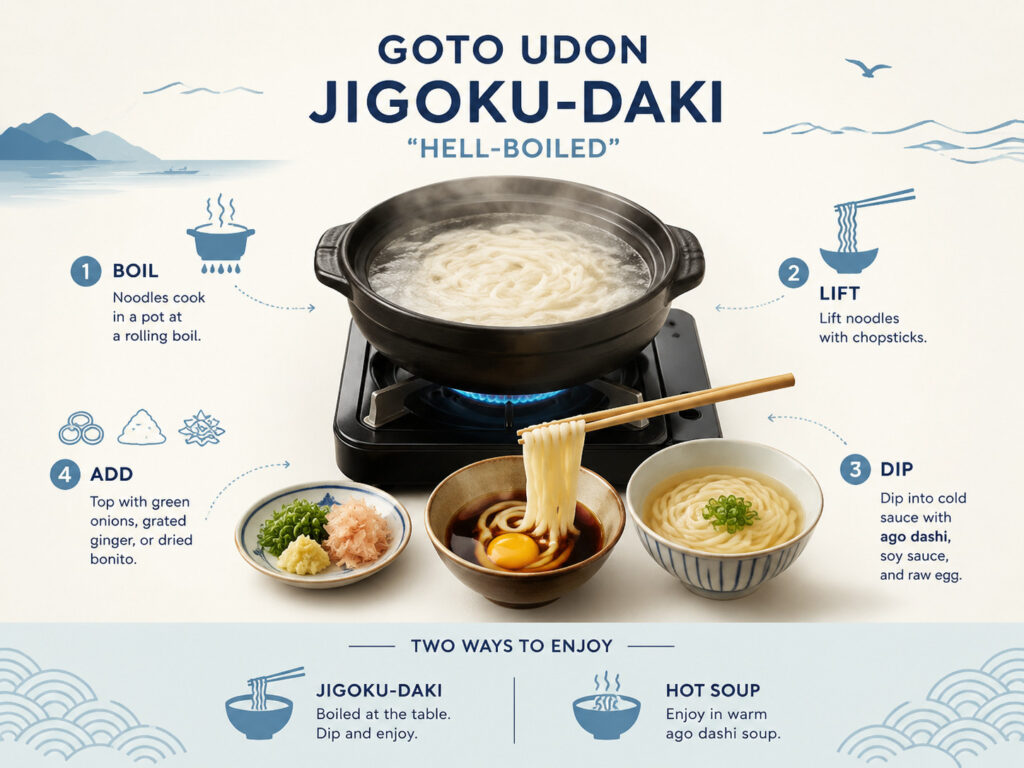
The most iconic way to eat Goto udon is jigoku-daki, which translates literally as “hell-boiled.” A clay or iron pot of water comes to the table still at a rolling boil, placed directly on a small portable burner. The noodles cook right in front of you. You lift them out of the scalding water with chopsticks and dip them immediately into a cold sauce built around ago dashi, soy sauce, and often a raw egg.
Visually dramatic, the meal is actually intimate and communal. Diners share from the same pot. The contrast between the boiling noodles and the cool dipping sauce is part of the experience. The egg softens the saltiness of the soy and adds a rich coating to each slippery strand. Locals often add green onions, grated ginger, or dried bonito on top to layer in more depth.
The noodles also work well in a straightforward hot soup — thin, round, and smooth in a bowl of warm ago dashi. Both styles are common in island restaurants.
How to Make Goto Udon Jigoku-Daki at Home
Ingredients (serves 2):
- Dried Goto udon noodles
- Flying fish (ago) dashi stock
- Soy sauce and mirin
- Raw egg (optional but recommended)
- Green onions, grated ginger, dried bonito (optional toppings)
Steps:
- Set a clay pot or heavy pot of water over a portable burner on the table. Bring to a full boil.
- Add the dried noodles. Cook for around 8–10 minutes until just tender.
- Combine ago dashi, soy sauce, and mirin in a small dipping bowl for each person. Add a raw egg if using, and stir lightly.
- Lift the noodles directly from the boiling pot with chopsticks. Dip and eat immediately while still hot.
- Add toppings to the dipping sauce as you go.
If a portable burner isn’t available, boil the noodles in the kitchen and bring them to the table in the pot — still in the water — and serve right away.
Ago Dashi: The Perfect Pairing
Ago dashi is made from flying fish that are charcoal-grilled, then dried. Compared with bonito-based dashi, ago dashi tends to taste cleaner and sweeter, with less of the aggressive smokiness that bonito can carry. It has a refined quality — rich but not heavy. This is what makes it work so well as a dipping sauce base rather than just a soup broth.
Flying fish caught off Nagasaki Prefecture are at their best in autumn. The drying and smoking process concentrates the flavor considerably. The result is a stock unique to this corner of Kyushu, and one that pairs naturally with Goto’s camellia oil noodles.
Nagasaki’s broader food culture has long been shaped by international exchange — Champon, Sara Udon, and Shippoku Ryori all reflect this layered history. Goto udon belongs to the same tradition, but from the islands rather than the port city — quieter, older, and shaped by different forces entirely.
Where to Try and Buy Goto Udon
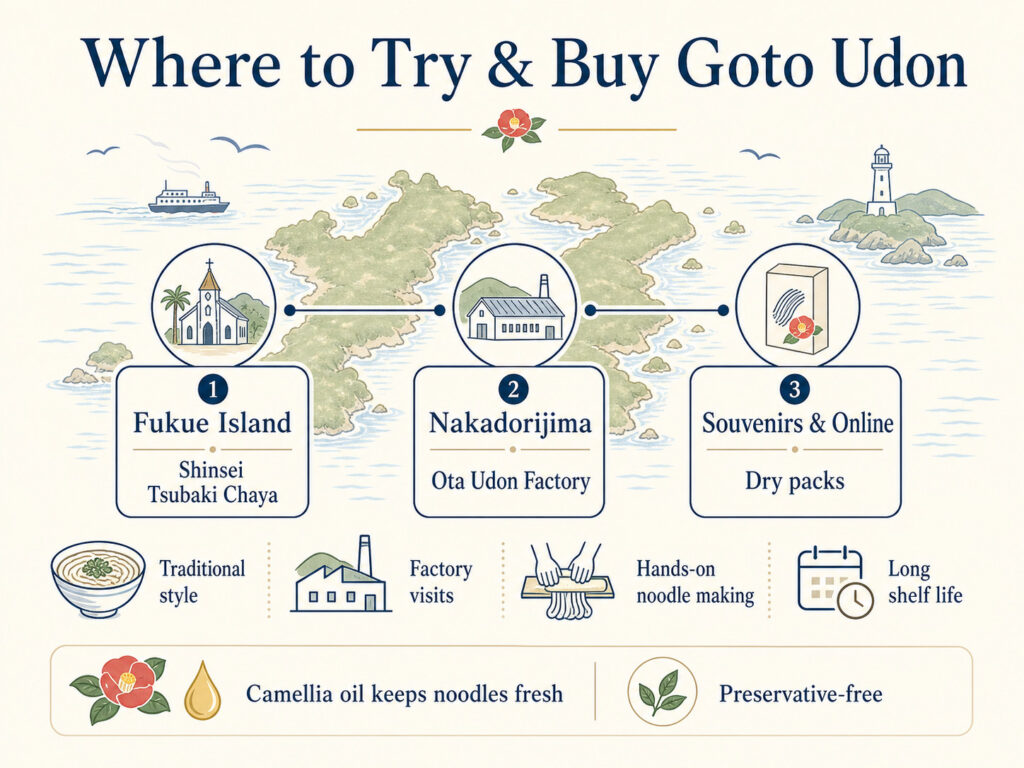
On Fukue Island, the largest in the Goto chain, restaurants like Shinsei and Tsubaki Chaya serve the noodles in traditional style. On Nakadorijima, the Ota Udon Factory (Ota Seimenjo) is the oldest surviving Goto udon maker, now in its second century of operation. Factory visits and hands-on noodle-making experiences are available there — worth planning ahead if you’re making the trip.
The Goto Hand-Stretched Udon Cooperative (Goto Tenobe Udon Kyodo Kumiai) helps connect producers and promotes the region’s noodles both domestically and internationally. Dried Goto udon packs are sold widely as souvenirs across Nagasaki Prefecture and online. The camellia oil treatment means the dried noodles keep well without preservatives, making them an ideal item to bring home or order online.
If you’re exploring Japanese noodle culture more broadly, the Japanese Noodles guide on foodinjapan.org covers the full range — from Goto’s fine, round strands to the dramatically wide flat noodles of Himokawa udon in Gunma. The differences, once you start noticing them, are surprisingly large.
Final Thoughts
Goto udon wasn’t designed for visitors. It developed on a remote island chain, refined over generations, shaped by the specific ingredients available there: island wheat, sea salt, local flying fish, and wild camellia trees. The jigoku-daki ritual, the ago dashi pairing, the migaki polishing step — none of it came from tourism. It came from the people who lived there.
That’s exactly what makes it worth seeking out. One bowl of these thin yet chewy, smooth and silky noodles in a flying fish broth tells you more about Nagasaki’s island history than most guidebook entries. Some food does that. Goto udon is one of them.
Goto Udon FAQ
What is Goto udon?
It represents a premium, hand-stretched noodle dish from Nagasaki Prefecture. Local families use native camellia oil and pure sea salt to craft these exceptionally thin, rounded strands. Food lovers prize these noodles for their glossy appearance and surprisingly firm, springy texture. Traditional shops typically serve them hot alongside savory dipping sauces made from local flying fish.
Is Goto udon really one of Japan’s three great udon?
Regional tourism guides and food media in Nagasaki widely describe it that way alongside Sanuki from Kagawa and Inaniwa from Akita. Although the “big three” designation lacks an official government certification, it accurately reflects how people generally position these noodles in Japanese regional culinary culture. Food lovers highly respect this traditional ranking across the entire country.
What makes Goto udon smooth and slippery?
Two key factors work together to create this wonderfully sleek texture. First, the traditional hand-stretching (te-yori) method builds a specific, springy elasticity in the wheat gluten. Second, brewers apply local camellia oil to coat the dried surface of the strands. The rich oil fills in microscopic surface irregularities, producing a smooth, polished finish while preventing clumping during boiling.
What is jigoku-daki?
This dramatic dining method, which translates to “hell-boiling,” represents the traditional way to enjoy this regional specialty. The host brings a pot of boiling water directly to the dining table on a portable stove. Diners lift the hot noodles straight from the bubbling water and dip them into a savory flying fish (ago) dashi sauce. The descriptive name refers directly to the violent look of the bubbling pot at the center of the table.
Can you buy Goto udon outside Japan?
Yes, you can easily purchase these dried noodles through international Japanese online retailers and select specialty Asian food stores. Because manufacturers air-dry the dough using natural camellia oil and add absolutely no artificial preservatives, the product travels well and maintains a long shelf life. We highly recommend checking Japanese grocery specialists or online marketplaces that regularly stock regional culinary imports.
Where does Goto udon come from?
This distinct noodle originates from the remote Goto Islands in Nagasaki Prefecture. Local families have crafted these thin, strong strands since the ancient Nara period. Buddhist monks and Chinese envoys originally brought the wheat processing and stretching techniques to the islands over a thousand years ago.
What does Goto udon taste like?
It delivers a wonderfully mild, sweet wheat flavor with a delicate hint of herbal camellia oil. The thin, rounded shape feels incredibly smooth, slippery, and surprisingly firm on the tongue. Diners frequently praise its remarkable elasticity and clean, refreshing aftertaste.
Where can I eat Goto udon in Japan?
You will find the absolute best bowls throughout the Goto Islands in Nagasaki Prefecture. Local restaurants near the ports and inside historic hotels serve the fresh noodles daily. Specialized regional diners in Nagasaki City and Tokyo also stock these premium dried strands for their regular customers.
How much does Goto udon cost?
A standard bowl at a local restaurant typically costs between 600 and 1,000 yen. Prices vary slightly depending on the specific toppings and the premium quality of the dipping sauce. Gift boxes containing dried packs usually cost between 2,000 and 5,000 yen at souvenir shops.
Is Goto udon vegetarian or vegan friendly?
The noodles themselves contain absolutely no animal products. However, the traditional dipping sauce (ago dashi) heavily relies on dried flying fish. Vegans and vegetarians can safely enjoy this 100% plant-based meal by substituting a simple soy-and-kelp dipping sauce at home.
What is the difference between Goto udon and Sanuki udon?
The main difference involves the thickness of the noodles and the shaping technique. This Nagasaki specialty features ultra-thin, round noodles coated in local camellia oil. Meanwhile, the Kagawa variety relies on much thicker, square-cut, oil-free noodles that offer a heavier, more solid chew.
References
- Goto Udon Official Website (Goto Tenobe Udon Kyodo Kumiai): https://www.goto-udon.jp/eng/ (accessed 2026)
- Discover Nagasaki – Food Journey Through Goto Islands: https://www.discover-nagasaki.com/en/featured-topics/foodingoto (accessed 2026)
- Visit Kyushu – Goto Udon: Delicious Legacy of Nagasaki’s Ancient Trade Routes: https://www.visit-kyushu.com/en/blogs/goto-udon-delicious-legacy-nagasakis-ancient-trade-routes/ (accessed 2026)
- Ministry of Agriculture, Forestry and Fisheries (MAFF) Japan – Jigokudaki (Goto Udon): https://www.maff.go.jp/e/policies/market/k_ryouri/search_menu/4008/index.html (accessed 2026)
- The Japan News / Spokesman-Review – “Town in Japan’s Goto Islands touts its unique twist on traditional udon noodles”: https://www.spokesman.com/stories/2025/jan/08/town-in-japans-goto-islands-touts-its-unique-twist/ (January 2025)
- Umami Insider – Ultimate Guide to Japanese Dashi Stock: https://umami-insider.com/blogs/blog/ultimate-guide-to-japanese-dashi-stock (accessed 2026)
- Japan Journeys – Goto Udon: One Heavenly Hell Pot: https://japanjourneys.jp/nagasaki/lifestyle/dining/goto-udon/ (accessed 2026)
- Japan Unknown – Exploring Japan’s Udon Culture: https://japan-unknown.com/2025/07/10/udon/ (accessed 2026)





 English (US) ·