
 1 month ago
42
1 month ago
42
Most people do not think much about green onions. They are a garnish, a background note, an afterthought. Then you eat a Shimonita negi, and that changes.
下仁田ネギ (Shimonita negi) is a premium Japanese green onion from Shimonita Town in Gunma Prefecture. It is thick, short, and intensely sweet when cooked. For centuries, this vegetable has held a special place in Japanese cuisine. And honestly, once you understand what makes it different, the reverence makes complete sense.
TOC
What Is Shimonita Negi?
Shimonita negi is a single-stalk variety of Japanese negi. It belongs to the Kaga group, one of the major classifications of Japanese long onion. Unlike most negi, it does not divide into multiple stalks. It grows as one thick, white stem.
The size is notable. The white base can reach 5 to 6 centimeters in diameter. That is closer to a leek than a scallion. The stalk is short and stocky, not slender and long like other varieties. Even the green tops are thicker than average.
But the defining quality is what happens when heat hits it. The pungency disappears. The sharp edge softens. What remains is a deep, mellow sweetness that surprises most people the first time.
If you are already familiar with negi dishes, you may know how negi nuta showcases the natural sweetness of premium Japanese green onions. Shimonita negi takes that quality to another level entirely.
Why Is Shimonita Negi So Famous?
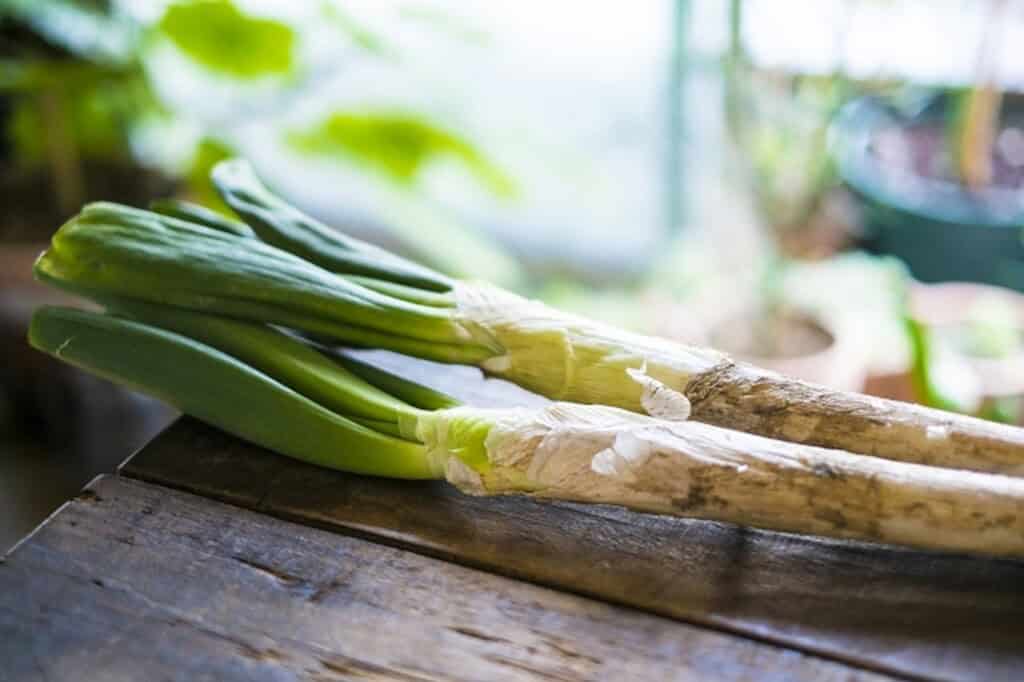
The nickname says it all. People in Japan call it “Tonosama Negi,” which means the lord’s negi. During the Edo period, this vegetable was considered too fine for ordinary people. It was reserved for samurai lords and the ruling class. That reputation has stuck, even if the ingredient is now more widely available.
What earns it that status? Three things work together.
First, the soil. Shimonita Town sits in a narrow valley where the climate is mild and the soil drains exceptionally well. The cold winters and temperature fluctuations stress the plant in ways that concentrate sugars.
Second, the cultivation method. Farmers earth up the soil around the growing stalk repeatedly. This technique forces the white portion to extend and develop without exposure to sunlight. The process takes time and skill. It cannot be rushed.
Third, the variety itself. The Shimonita negi is a single-stalk heirloom. Each plant produces one thick stem rather than multiple thin ones. That concentration of energy into a single shoot seems to intensify both texture and flavor.
The result is a negi with a sugar content noticeably higher than standard varieties. When grilled or simmered, the flesh becomes almost custard-like. There is no bitterness left. Just warmth, sweetness, and a lingering umami depth.
A Brief History
Records of Shimonita negi cultivation stretch back several centuries. The Edo period, roughly from the early 1600s to the mid-1800s, is when the vegetable gained its association with aristocratic dining. The lords of the region controlled access to it. Commoners rarely tasted it.
Shimonita Town itself sits in Kanra District, in the western part of Gunma Prefecture. The town has long been known for premium vegetables. Alongside Shimonita negi, the area produces high-quality konnyaku (konjac), and the fertile valley has supported specialized agriculture for generations.
As Japan modernized in the Meiji era and market access expanded, Shimonita negi gradually became available beyond the local elite. But production remained small. The growing conditions required in Shimonita Town are specific enough that the vegetable cannot simply be replicated elsewhere. Attempts to grow it in other regions have typically produced a different result: a reasonable-looking negi that lacks the concentrated sweetness of the original.
Today, Shimonita Town guards the name carefully. The local agricultural cooperative oversees production standards. Shimonita negi with the official designation comes only from the town.
Gunma’s identity as a negi-producing region runs deep. You can explore more of what this prefecture offers through the Gunma local food section on foodinjapan.org.
How to Eat Shimonita Negi
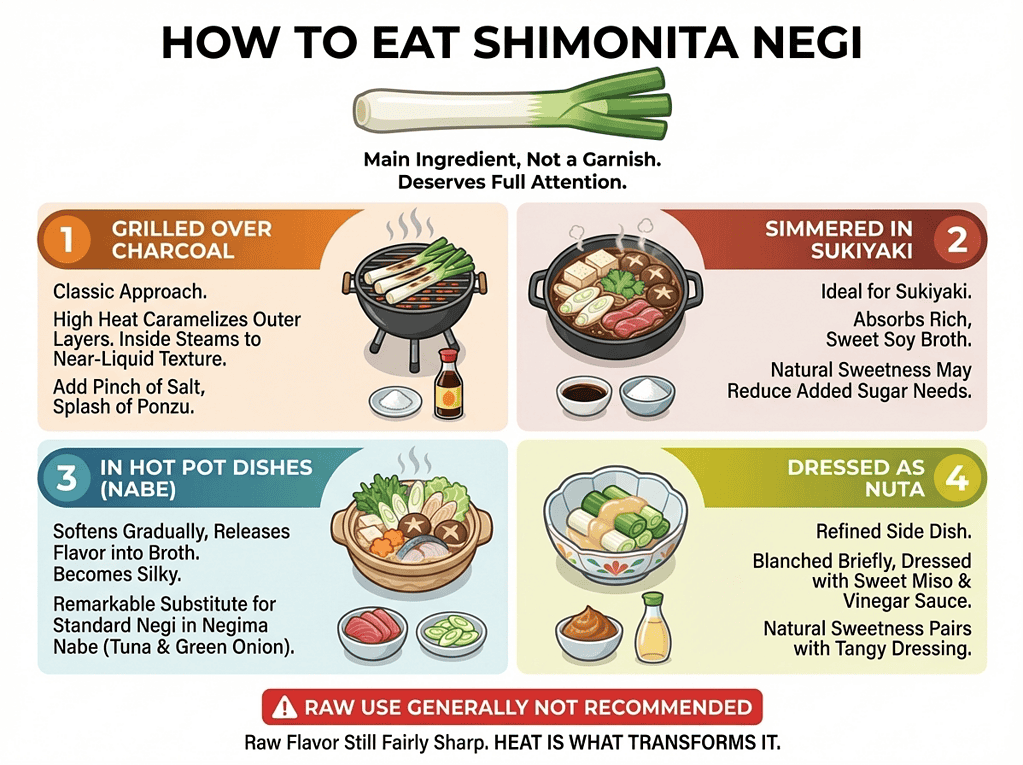
This is where things get particularly interesting. Shimonita negi is not a garnish. It is a main ingredient, deserving full attention.
Grilled over charcoal. This is the classic approach. The high heat caramelizes the outer layers. The inside steams and softens to a near-liquid texture. A pinch of salt, a splash of ponzu, and that is all you need. The negi does the rest.
Simmered in sukiyaki. The sweetness of Shimonita negi makes it ideal for sukiyaki, where it absorbs the rich, sweet soy broth and adds its own layer of depth. Many home cooks across Japan consider it the best negi for this dish. Some say you need less added sugar when using it, because the negi itself contributes enough.
In hot pot dishes. The negi softens gradually in a simmering nabe, releasing its flavor into the broth. It becomes almost silky. If you enjoy negima nabe, the classic Tokyo hot pot of tuna and green onion, Shimonita negi makes a remarkable substitute for standard negi.
Dressed as nuta. Blanched briefly, then dressed with a sweet miso and vinegar sauce, Shimonita negi can anchor a refined side dish. The natural sweetness pairs well with the tangy miso dressing without either element overpowering the other.
Raw use is generally not recommended. The raw flavor is still fairly sharp. Heat is what transforms it.
Shimonita Negi vs Other Premium Japanese Negi
Japan produces several celebrated negi varieties. Comparing them helps clarify what makes Shimonita negi distinct.
Fukaya negi from Saitama Prefecture is perhaps the most widely distributed premium negi in eastern Japan. It has long, elegant white stalks and a reliable sweetness. It is refined and versatile. But it is thinner and more slender than Shimonita negi, and the texture difference when cooked is significant.
Kujo negi from Kyoto is a leaf negi, prized for its tender green parts and mild flavor. It suits lighter preparations and is foundational in Kyoto cuisine. Its character is quite different from the bold, thick presence of Shimonita negi.
Shimonita negi is the extreme end of the spectrum. It is the most physically dramatic, the most intensely sweet when cooked, and the most closely tied to a specific place of origin. Among enthusiasts, it is often described simply as the finest negi in Japan.
Where to Find Shimonita Negi
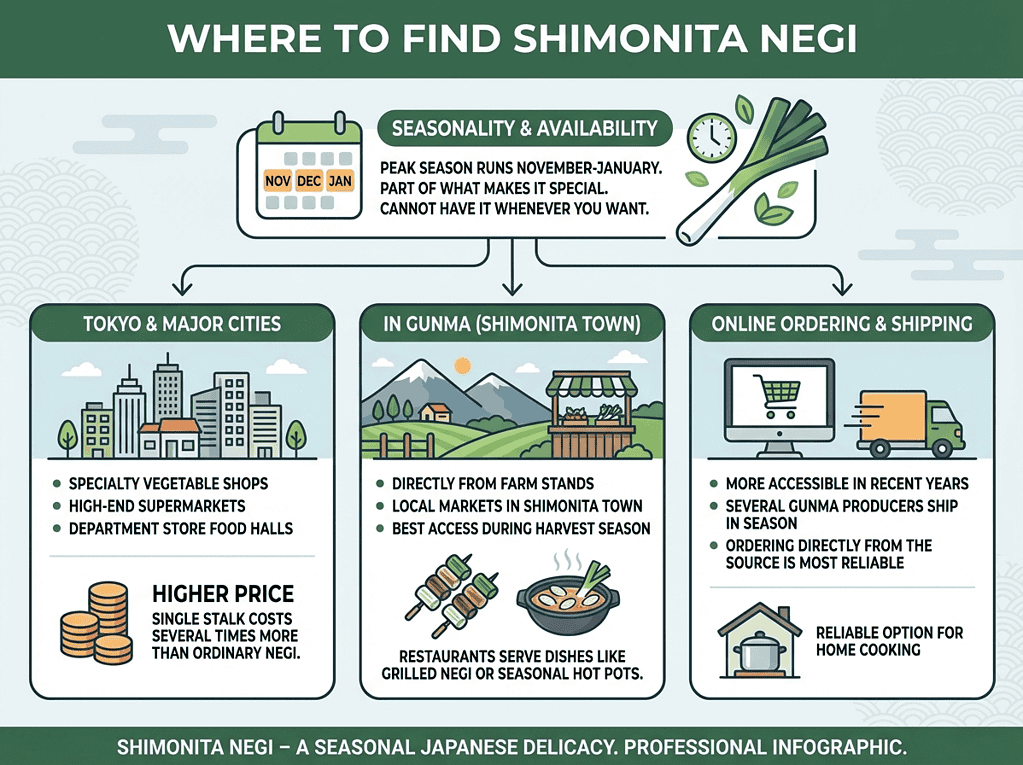
The peak season runs from November through January. Outside that window, the negi is either not yet harvested or long gone from market shelves. This seasonality is part of what makes it special. You cannot have it whenever you want.
In Tokyo and other major cities, Shimonita negi appears at specialty vegetable shops, high-end supermarkets, and some department store food halls during the season. It carries a noticeably higher price than ordinary negi. A single stalk can cost several times what a regular green onion would.
In Gunma itself, you can sometimes buy it directly from farm stands or local markets in Shimonita Town. Visiting during the harvest season offers the best access. Some restaurants in the region serve dishes centered on the negi, grilled simply or featured in seasonal hot pots.
Online ordering has made it more accessible in recent years. Several Gunma agricultural producers ship during the season. If you plan to cook with it at home, ordering directly from the source is often the most reliable option.
Shimonita Negi Today
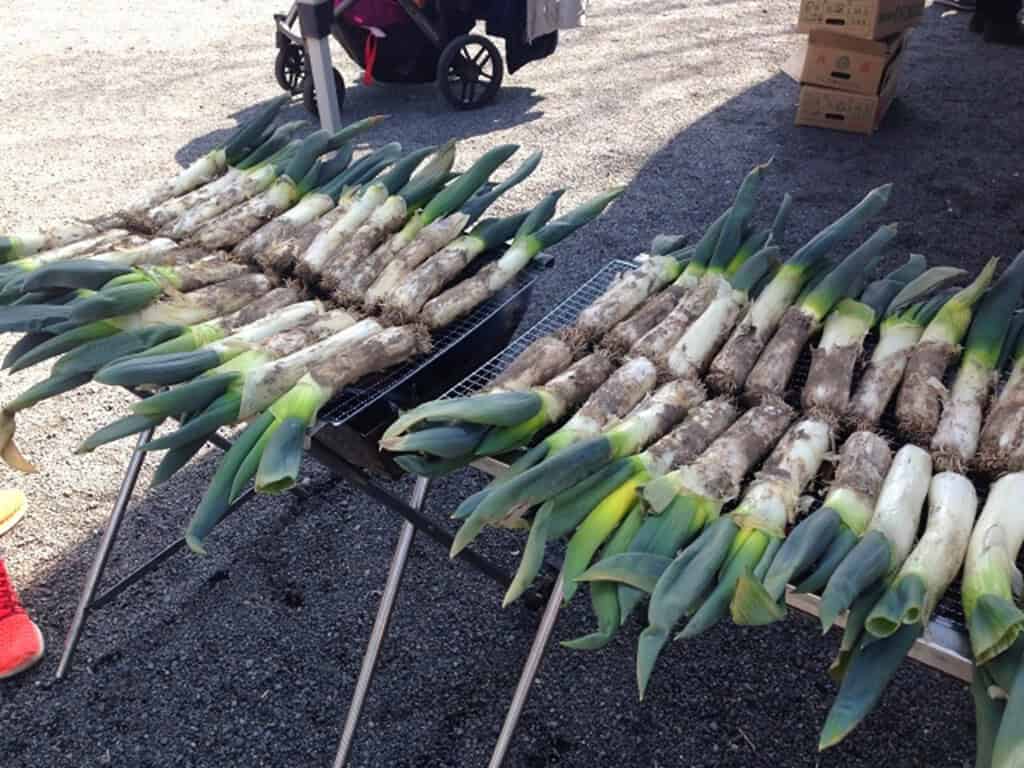
The vegetable’s reputation has only grown stronger in recent decades. Japanese chefs at high-end restaurants increasingly feature it as a seasonal highlight. Food media covers it each winter. Visitors make the trip to Shimonita Town specifically to taste it.
Yet the supply remains deliberately limited. The town and its farmers have not scaled up production in ways that would compromise quality. That restraint is unusual in a food culture that often seeks to meet demand. It speaks to a kind of shared pride in what Shimonita negi represents.
It is a vegetable that rewards patience. You wait for the season. Find a good source. Cook it simply. And then you understand why people have been seeking it out for hundreds of years.
References
- Visit Gunma Prefecture: https://www.visitgunma.jp/en/
- Sudachi Recipes (Negi varieties): https://sudachirecipes.com/negi/
- Kikkoman Glossary (Negi): https://www.kikkoman.com/en/cookbook/glossary/negi.html
- WASHOKU Japanese Food Culture (Negi types): https://washokufood.blogspot.com/2008/07/naganegi-leek.html





 English (US) ·