
 3 weeks ago
61
3 weeks ago
61
Walk into a sake shop for the first time, and you’ll likely freeze. The different types of Japanese sake fill the shelves with unfamiliar labels. The bottles look similar. And nobody told you that the flavor difference between one style and the next can be enormous.
Here’s the good news: sake classification follows a clear logic. Once you understand the types of Japanese sake, choosing a bottle becomes much easier. The logic starts with a single question: how much of the rice grain did the brewer remove before fermentation?
TOC
How Types of Japanese Sake Are Classified: Rice Polishing Ratio
Sake rice is not the same as table rice. Brewers polish it before use, grinding away the outer layers to expose the starchy core inside. The more polishing, generally the cleaner and more aromatic the final sake tends to be.
Brewers express polishing as a percentage of the grain remaining. So a rice polishing ratio of 60% means the brewer removed 40% of the outer grain. A ratio of 50% means half the grain is gone. Lower numbers mean more polishing, and often more delicacy in the final product.
Japan’s National Tax Agency uses this ratio as the basis for classifying the types of Japanese sake. Combined with the presence or absence of added distilled alcohol, polishing ratio determines which official category a sake falls into.
Think of it as a spectrum from rich to light: the less rice remaining, the more fragrant and delicate the sake usually becomes.
All Types of Japanese Sake at a Glance
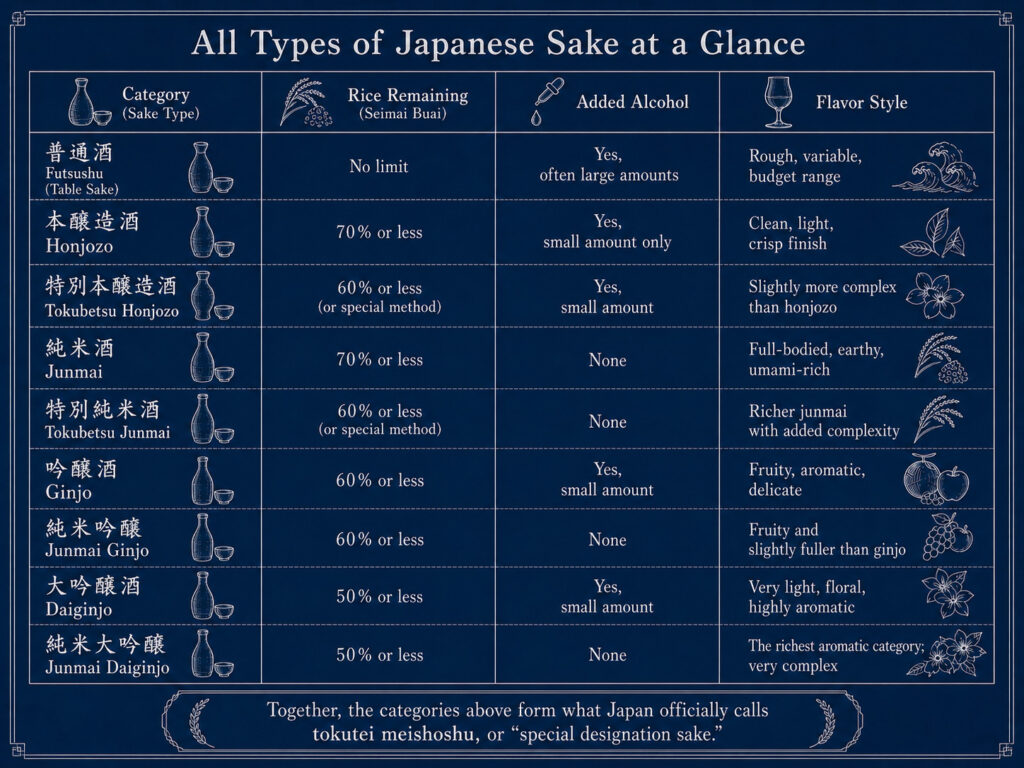
Before going deeper, here’s a comparison of the primary sake categories in one place.
| Futsushu (table sake) | No limit | Yes, often large amounts | Rough, variable, budget range |
| Honjozo (本醸造酒) | 70% or less | Yes, small amount only | Clean, light, crisp finish |
| Tokubetsu Honjozo | 60% or less (or special method) | Yes, small amount | Slightly more complex than honjozo |
| Junmai (純米酒) | 70% or less | None | Full-bodied, earthy, umami-rich |
| Tokubetsu Junmai | 60% or less (or special method) | None | Richer junmai with added complexity |
| Ginjo (吟醸酒) | 60% or less | Yes, small amount | Fruity, aromatic, delicate |
| Junmai Ginjo (純米吟醸) | 60% or less | None | Fruity and slightly fuller than ginjo |
| Daiginjo (大吟醸酒) | 50% or less | Yes, small amount | Very light, floral, highly aromatic |
| Junmai Daiginjo (純米大吟醸) | 50% or less | None | The richest aromatic category; very complex |
Together, the categories above form what Japan officially calls tokutei meishoshu, or “specially designated sake.” Futsushu (ordinary sake) sits outside this group and carries no polishing requirement.
Junmai Sake: Rich, Full, and Unapologetically Savory
Junmai (純米) means “pure rice.” No distilled alcohol added. Just rice, koji, and water.
Because junmai uses only fermentation-derived alcohol, it typically carries more body and a stronger umami character than alcohol-added styles. The flavor profile tends toward earthy, slightly tangy, and savory. Some people love it immediately. Others find it a bit much on the first sip.
Junmai often works beautifully when served warm (around 45°C), which brings out its rounder, more mellow qualities. It also pairs well with bold, savory dishes: yakitori, fried chicken, miso-glazed eggplant, grilled mackerel.
Junmai Ginjo and Junmai Daiginjo follow the same no-added-alcohol rule, but with higher polish requirements. As a result, they’re more aromatic while retaining some of that junmai body.
Ginjo Sake: Fruity, Fragrant, and Worth the Price
Ginjo (吟醸) requires at least 40% of the rice to be removed before brewing. The brewer ferments the polished rice slowly at low temperatures, a technique called ginjo-zukuri. This slow fermentation produces fruity, aromatic compounds, particularly isoamyl acetate, which gives many ginjo their signature banana or apple note.
Ginjo sake feels lighter than junmai on the palate. It has a cleaner finish and a more obvious fragrance. Serve it well-chilled in a wine glass. That choice of glassware is not just an aesthetic decision; it actually helps concentrate the aroma.
Food pairings work differently here. Because ginjo can be quite delicate, overly rich or spiced dishes tend to overwhelm it. Sashimi, steamed shellfish, and light salads work better. Ginjo is also enjoyable on its own, as a sipping sake before or after a meal.
Daiginjo Sake: The Most Refined Category
Daiginjo (大吟醸) pushes polishing even further. At least 50% of the rice grain must be removed, which means the brewer starts with half the rice they originally milled. The resulting sake is exceptionally clean, floral, and aromatic.
Making daiginjo is labor-intensive and expensive. Brewers spend weeks managing fermentation temperatures precisely. Many daiginjo are produced in small quantities, and prices reflect that effort.
Flavor-wise, daiginjo sits at the lightest, most fragrant end of the sake spectrum. Think: light and floral, almost perfume-like, with a soft, elegant finish. A good daiginjo is genuinely impressive, even to people who don’t usually drink sake.
Chill it. Use a delicate glass. Drink it slowly.
Honjozo Sake: The Accessible Middle Ground
Honjozo (本醸造酒) is often the most practical choice for everyday drinking. Brewers add a small amount of distilled alcohol during production, not to inflate volume, but to refine the aroma and create a lighter, crisper finish.
The addition is tightly regulated. Brewers cap it at 10% of the total rice weight. Used correctly, the alcohol draws out volatile aromatic compounds that would otherwise stay locked in the mash. The result is a cleaner, more refreshing sake than junmai at a lower price point.
Honjozo works both chilled and warm, which makes it unusually versatile. It pairs well with sushi, tempura, grilled fish, and yakitori. For anyone new to sake, honjozo is a very smart place to begin. You can read more about honjozo’s flavor and history in the dedicated honjozo sake guide on this site.
More Types of Japanese Sake: Specialty Styles Worth Knowing
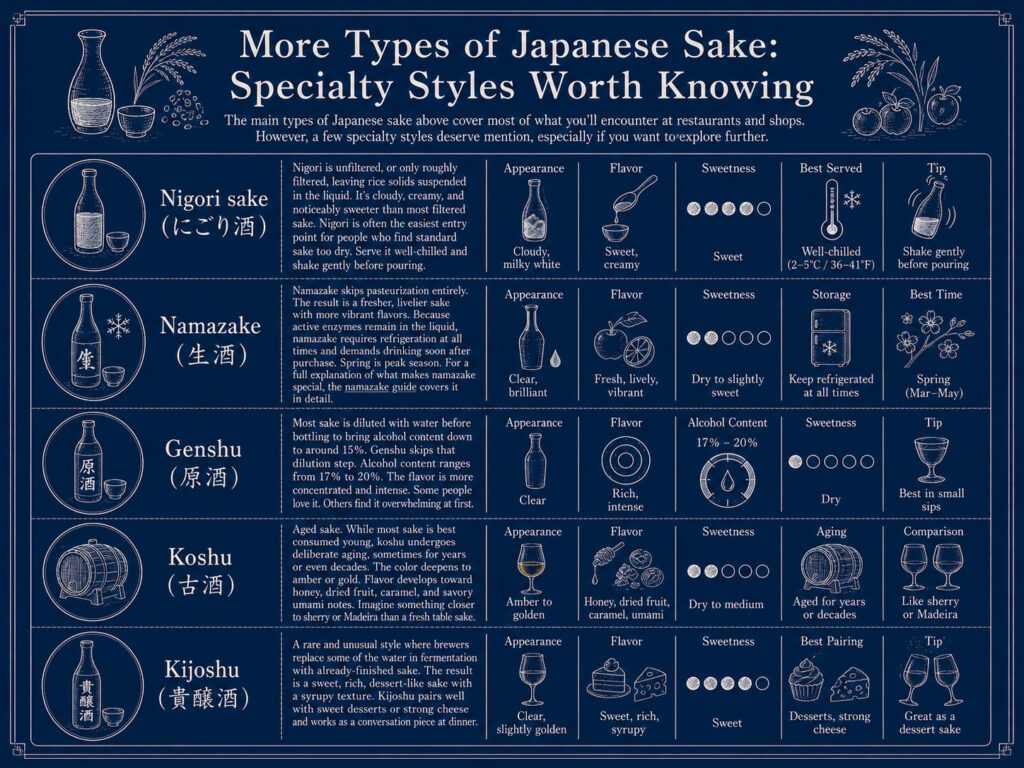
The main types of Japanese sake above cover most of what you’ll encounter at restaurants and shops. However, a few specialty styles deserve mention, especially if you want to explore further.
Nigori sake (にごり酒) Nigori is unfiltered, or only roughly filtered, leaving rice solids suspended in the liquid. It’s cloudy, creamy, and noticeably sweeter than most filtered sake. Nigori is often the easiest entry point for people who find standard sake too dry. Serve it well-chilled and shake gently before pouring.
Namazake (生酒) Namazake skips pasteurization entirely. The result is a fresher, livelier sake with more vibrant flavors. Because active enzymes remain in the liquid, namazake requires refrigeration at all times and demands drinking soon after purchase. Spring is peak season. For a full explanation of what makes namazake special, the namazake guide covers it in detail.
Genshu (原酒) Most sake is diluted with water before bottling to bring alcohol content down to around 15%. Genshu skips that dilution step. Alcohol content ranges from 17% to 20%. The flavor is more concentrated and intense. Some people love it. Others find it overwhelming at first.
Koshu (古酒) Aged sake. While most sake is best consumed young, koshu undergoes deliberate aging, sometimes for years or even decades. The color deepens to amber or gold. Flavor develops toward honey, dried fruit, caramel, and savory umami notes. Imagine something closer to sherry or Madeira than a fresh table sake.
Kijoshu (貴醸酒) A rare and unusual style where brewers replace some of the water in fermentation with already-finished sake. The result is a sweet, rich, dessert-like sake with a syrupy texture. Kijoshu pairs well with sweet desserts or strong cheese and works as a conversation piece at dinner.
How to Choose Between Types of Japanese Sake: A Flavor Map
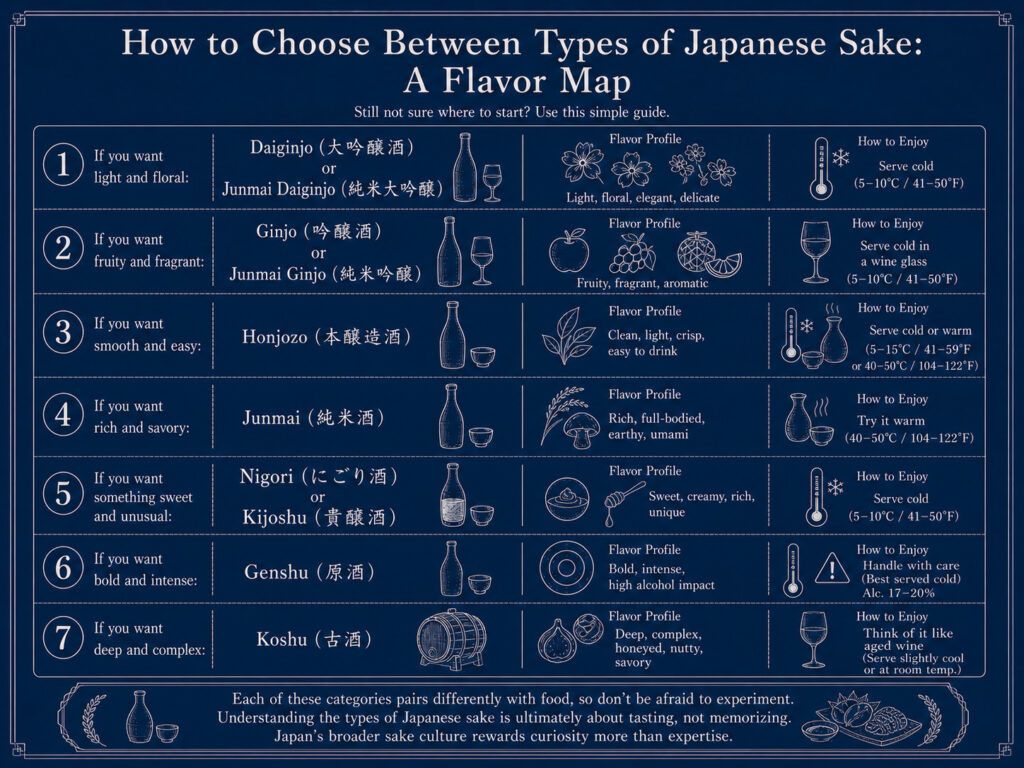
Still not sure where to start? Use this simple guide.
- If you want light and floral: Start with Daiginjo or Junmai Daiginjo. Serve cold.
- If you want fruity and fragrant: Try Ginjo or Junmai Ginjo. Serve cold in a wine glass.
- If you want smooth and easy: Honjozo is your friend. Serve cold or warm.
- If you want rich and savory: Junmai is the right direction. Try it warm.
- If you want something sweet and unusual: Nigori or Kijoshu. Serve cold.
- If you want bold and intense: Genshu. Handle with care.
- If you want deep and complex: Koshu. Think of it like aged wine.
Each of these categories pairs differently with food, so don’t be afraid to experiment. Understanding the types of Japanese sake is ultimately about tasting, not memorizing. Japan’s broader sake culture rewards curiosity more than expertise.
A Final Word on
Warm vs Cold
One question comes up constantly: should sake be served warm or cold?
Always Serve Cold
Daiginjo & Ginjo
Warming destroys the delicate aromatics that make these styles special. Always serve well-chilled.
Cold or Gently Warm
Junmai & Honjozo
Fuller styles tolerate warmth well and sometimes improve with gentle heating to around 45°C.
Common Myth
“Sake is only served warm” is a misconception, likely carried over from decades when futsushu dominated export markets. Premium sake is almost always chilled today. That shift reflects a broader evolution in how people, both inside and outside Japan, understand and appreciate it.
Start cold. Experiment from there.
References
- Japan Sake and Shochu Makers Association, “Sake Classification” (2023): https://www.japansake.or.jp/sake/english/know/classification.html
- Sake World (John Gauntner), “Sake Types and Grades” (2020): https://sake-world.com/html/flash/types.html
- The Japanese Bar, “Sake Classification: Everything You Need to Know” (2022): https://thejapanesebar.com/learn-sake/sake-classification/
- Tippsy Sake, “Complete Guide to Sake Types” (2023): https://www.tippsysake.com/blogs/sake-school/sake-types
- True Sake, “Sake 101: A Guide to Sake Categories for Beginners” (2023): https://www.truesake.com/blogs/news/sake-101
- National Tax Agency Japan, “Sake No Hinotebiki (Official Sake Labeling Guidelines)” (2020): https://www.nta.go.jp/english/




 English (US) ·